
POSH Act Compliance in Delhi: Are You Prepared for a Workplace Compliance Audit?
Jul 04, 2026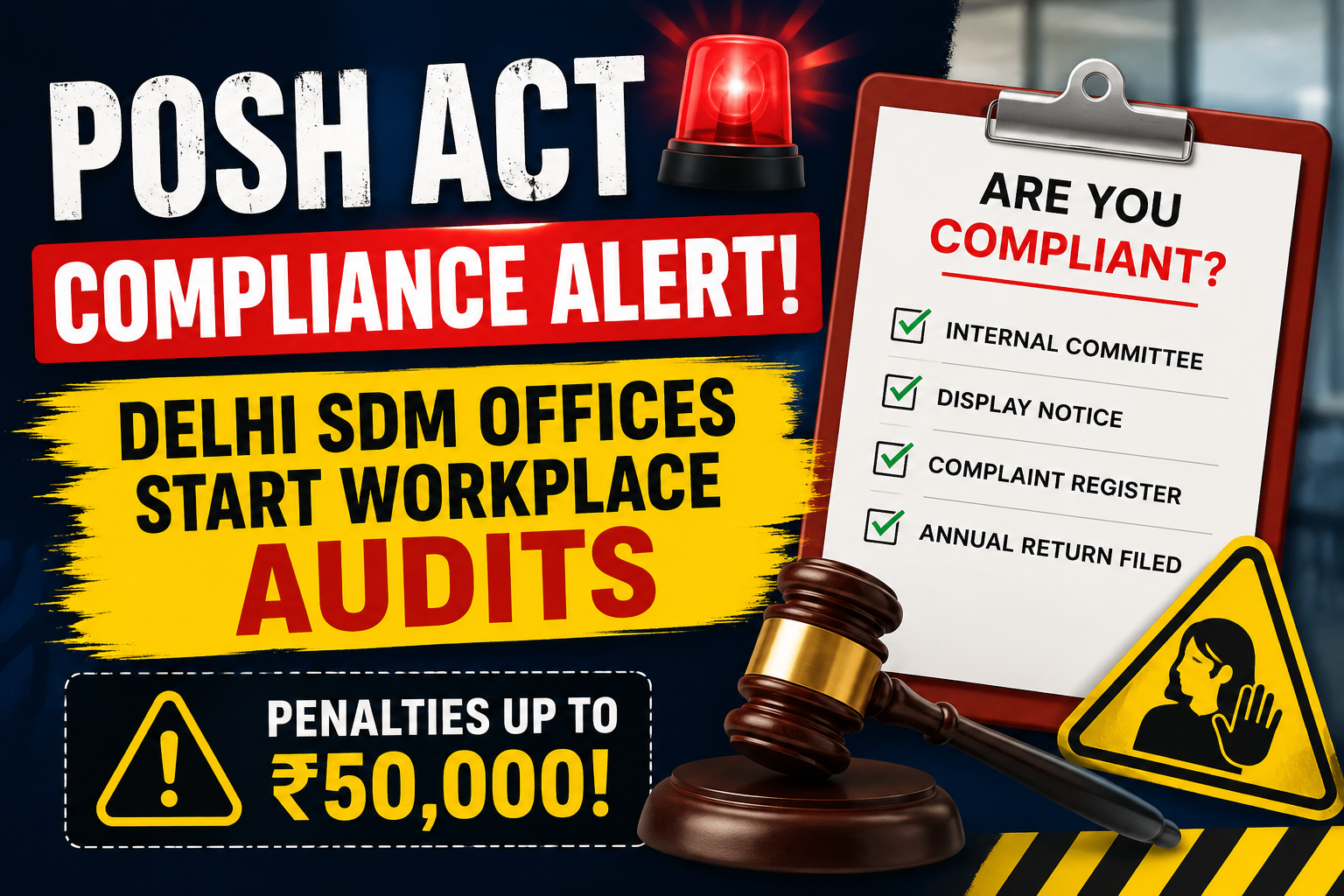
The regulatory focus on workplace compliance is increasing, and employers can no longer afford to treat the POSH Act, 2013 as a mere HR formality.
Recent reports indicate that Delhi SDM Offices have started conducting compliance audits under the Sexual Harassment of Women at Workplace (Prevention, Prohibition and Redressal) Act, 2013 (POSH Act). Organizations across sectors—including MSMEs, startups, NGOs, hospitals, educational institutions, retail businesses, and corporate offices—should review their compliance framework immediately.
Ignoring POSH compliance today may result in significant legal and reputational consequences tomorrow.
What is the POSH Act?
The POSH Act, 2013 was enacted to ensure that every workplace provides a safe environment for women and establishes an effective mechanism for the prevention and redressal of complaints relating to sexual harassment.
Compliance is not merely a statutory obligation—it reflects an organization's commitment to ethical governance and employee welfare.
What Authorities May Verify During an Audit
Organizations may be required to furnish evidence relating to:
✔ Constitution of the Internal Committee (IC), wherever applicable
✔ POSH Policy approved by the management
✔ Display of statutory POSH notices at the workplace
✔ Maintenance of complaint registers and records
✔ Conduct of employee awareness and sensitization programmes
✔ Filing of Annual Reports/Returns with the appropriate authority, wherever applicable
Consequences of Non-Compliance
Failure to comply with the provisions of the POSH Act may result in:
- Penalty up to ₹50,000 for the first violation.
- Higher penalties for repeated defaults.
- Possible cancellation, suspension, or non-renewal of business licences or registrations in cases of repeated non-compliance, as provided under the Act.
- Damage to the organization's reputation and employee confidence.
- The financial penalty is often far less damaging than the reputational impact arising from regulatory action.
Is Your Organization Compliant?
Ask yourself these simple questions:
- Has an Internal Committee been properly constituted?
- Does your organization have a documented POSH Policy?
- Are mandatory notices displayed at all offices?
- Have employees received POSH awareness training?
- Are complaint registers and records properly maintained?
- Have statutory reporting requirements been complied with?
If the answer to any of these questions is "No" or "Not Sure", it is advisable to undertake an immediate compliance review.
Why Businesses Must Act Now
Many small and medium-sized businesses assume that POSH compliance applies only to large corporates.
This assumption can prove costly.
Regulators are increasingly focusing on governance and labour law compliance, and organizations of all sizes should proactively review their internal processes before receiving any notice.
Professional Advice
As Chartered Accountants, we frequently observe that businesses prioritize tax and GST compliances while overlooking labour law obligations.
A periodic Compliance Health Check covering labour laws, corporate compliances, tax regulations, and internal governance can help organizations identify gaps before regulatory authorities do.
Proactive compliance is always more economical than reactive litigation.
Final Thoughts
Compliance should never begin after a notice is received.
It should begin with good governance.
A compliant workplace not only minimizes legal exposure but also strengthens employee trust, enhances corporate reputation, and demonstrates responsible leadership.
Is your organization fully compliant with the POSH Act?
If you would like to discuss your organization's compliance readiness, feel free to connect.